
I said at the end of Part Two that the horses had something to say about leadership. They did, and I wrote about that. But it turned out the horses were just the beginning.
Our guide at Cha Cha Metsi was extraordinary. Over six days of riding through the Okavango Delta, he explained, quietly and without fanfare, how everything around us worked. How each species depended on another. How the landscape had been shaped not by the largest or most powerful creatures, but by the most consistent ones. How an ecosystem that looks, from a distance, like beautiful chaos is in fact an intricate, self-regulating system of mutual contribution.
By day three, I had stopped thinking of it as natural history. I was thinking about leadership.
Here is what I noticed, and what I think it means for the teams and leaders I work with.
Different strengths, shared purpose
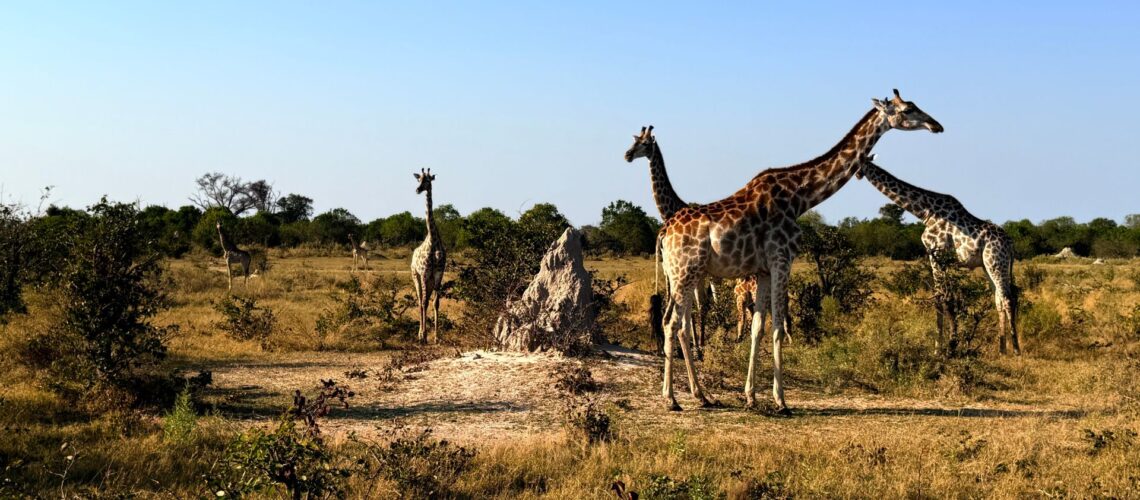
Across the Delta, you rarely see animals existing in isolation. Giraffes and zebras are frequently found together and it is not coincidence. Our guide explained that the two species have evolved complementary ways of sensing danger. Zebras are alert to threats at ground level, giraffes, with their extraordinary height and wide field of vision, scan the horizon. Together, they cover the landscape far more effectively than either could alone.
Neither species is in charge. Neither has subsumed its identity into the other. They are simply doing what they do well, in proximity to others who do something different equally well. The result is a group considerably safer and more resilient than the sum of its parts.
The leadership parallel. In high-performing teams, the most effective leaders are not those who replicate their own strengths across the group. They are the ones who actively seek out difference, in thinking style, in perspective, in the way people read a situation, and create the conditions for those differences to complement rather than compete. Diversity of approach is not a nice to have. In the wild, it is survival.
The relationship that works both ways
Perched on the necks and ears of the giraffes we rode alongside were small, neat birds, red-billed oxpeckers. Our guide told us these birds remove ticks and parasites from the giraffe’s skin, keeping the host healthy. In return, the giraffe provides a moving platform, a reliable food source, and a vantage point from which the oxpecker can raise the alarm if a predator approaches. Both give something. Both receive something. Neither could thrive quite as well without the other.
This relationship has a name in ecology: mutualism. And what makes it genuine mutualism, rather than one party simply tolerating the other, is that the contribution flows in both directions. The oxpecker is not a passenger. The giraffe is not a patron. They are partners.
The leadership parallel. Think about the relationships in your organisation that you describe as collaborative. Are they genuinely mutual, both parties contributing, both benefiting, or has one side quietly become the passenger? Sustainable working relationships, like sustainable ecosystems, require reciprocity. The moment the flow becomes one-directional, the relationship shifts, and not always in ways that are immediately obvious.
The smallest contributor, the largest impact
This is the one that stopped me completely.
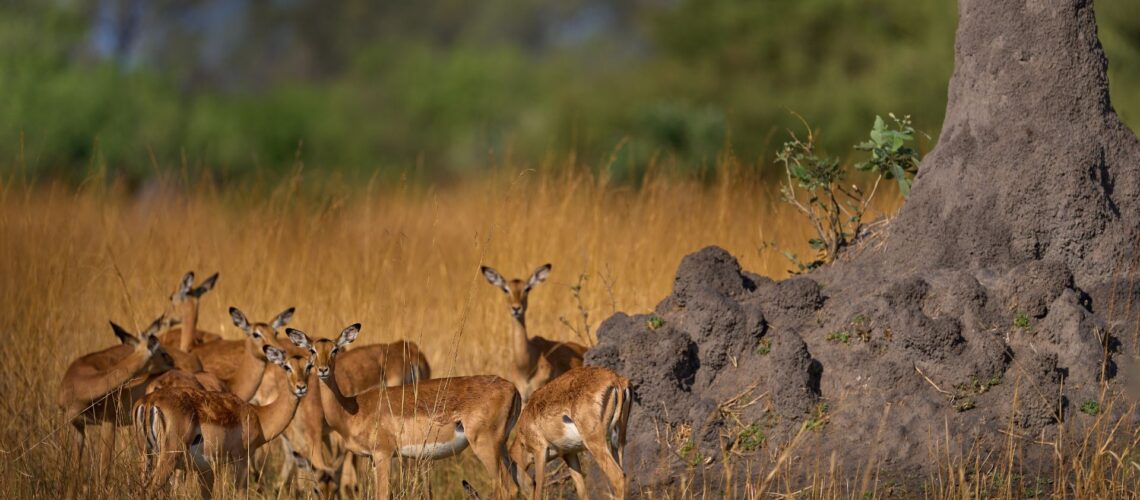
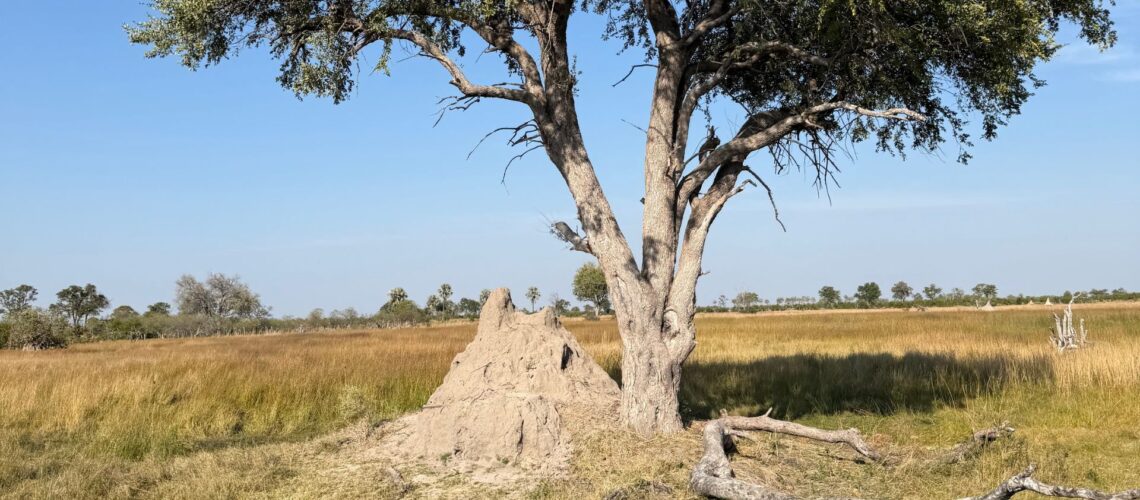
The Okavango Delta contains approximately 150,000 islands. I had assumed they were formed by water, or geological shift, or the movement of large animals over time. Our guide corrected me gently. The islands, he explained, were built primarily by termites.
Termites construct mounds just high enough to sit above the floodline. Seeds, carried in the droppings of birds and elephants, take root in the nutrient-rich soil. Trees grow. The trees trap dust and sediment. The mound becomes an island. The island becomes a refuge: a dry haven during floods, a navigation point for guides who would otherwise be lost in a flat, featureless landscape, a microhabitat that supports dozens of species who could not otherwise survive.
The termites are not managing this outcome. They are not aware of it. They are simply doing their work, consistently and collectively, and the cumulative effect has created the very structure that makes the whole ecosystem possible.
“The creatures responsible for building the foundations of this UNESCO World Heritage Site are invisible to most visitors. They are also indispensable to everything above them.”
The leadership parallel. Every organisation has its termites, the people whose consistent, unglamorous, often invisible work creates the conditions in which everything else can function. They are rarely the loudest voices in the room. But remove them, and the structure begins to shift in ways that take a long time to notice and a very long time to repair. Who are the quiet architects in your team? When did you last tell them what they are building?
The cycle that feeds itself
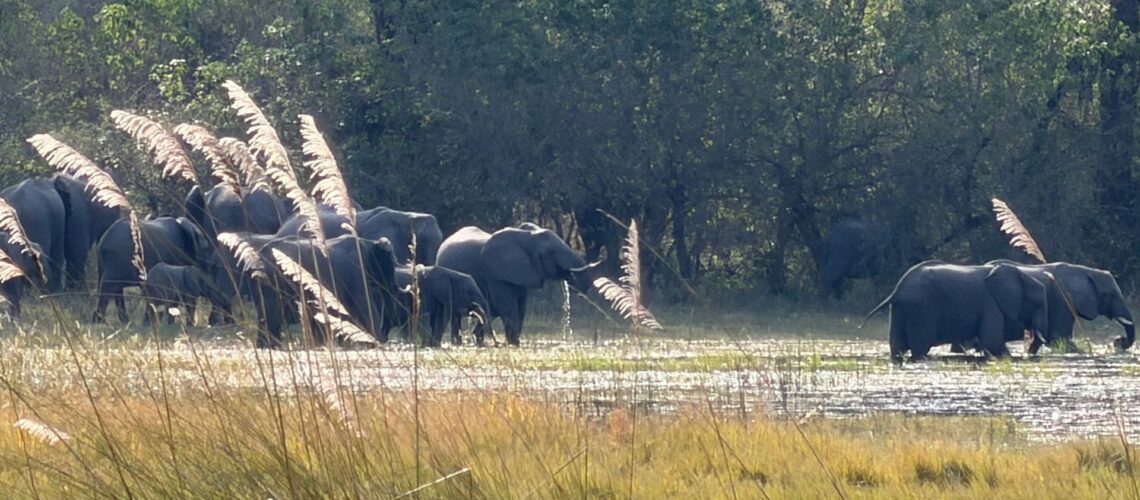
Our guide pointed to the palm trees scattered across the Delta, appearing where you would least expect them. He explained where they come from. Elephants eat the palm fruit. The seeds pass through the elephant and are deposited, often miles away, in droppings rich in nutrients. The palm germinates, grows, and in time the elephant returns to eat it.
The elephant is simultaneously cultivating its own future food supply and dispersing the ecosystem across the landscape. It does not know this. It is simply being an elephant. And yet the effect is a self-replenishing system that has sustained itself for millennia without anyone designing it.
The leadership parallel. The best leaders invest in people without a precise calculation of return. They develop others, share knowledge generously, create opportunities, and trust that the ecosystem they are building will sustain itself. Leadership that is purely extractive, that takes from the talent pool without replenishing it, eventually runs dry. The elephant does not hoard the fruit. It eats, moves on, and leaves something behind.
Frequently Asked Questions About Leadership Lessons From Nature
What the Delta keeps asking
I came to Botswana to go riding. I came home with a quietly different way of thinking about the organisations I work inside.
The Okavango Delta is not a perfect system, there is predation, competition, drought, flood and loss. But it is a remarkably resilient one. And what makes it resilient is not the strength of any single species. It is the quality of the relationships between them. The reciprocity. The complementarity. The invisible, consistent, foundational work that no one sees and everyone depends on.
The question I keep coming back to, and that I would offer to you, is this: if your organisation were an ecosystem, what would a good guide say about how it actually works? Where is the mutualism? Where are the termites? And what is being consumed without being replenished?
You don’t need to go to Botswana to ask it. But it helps.
This is Part Three of a series. If you missed them, Part One is about the decision to finally say yes, and Part Two is about what the Okavango Delta itself taught me.